
Work and Hiring
How to Onboard Your First Employees
TL;DR
- Onboarding starts before the first shift: tools, access, a written schedule, and the required forms should be ready so the new hire is not left waiting.
- Day one should cover how to get paid, how to stay safe, who to ask, and one or two real tasks — not a stack of policies alone.
- Check in at the end of week one and again around day 30. Short, scheduled conversations catch problems while they are still small.
- Use the same basic plan for every hire, then add job-specific training. That consistency is what a first-time supervisor can actually keep up.
Onboarding is the stretch between “you’re hired” and “this person can do the job without you standing there.” In a small shop, a hotel, or a department with a handful of people, that stretch often gets skipped. The new hire shadows whoever is working, papers are signed at some point, and everyone hopes it sticks. A short, repeatable plan works better, and you can run it without a human-resources staff. This is a practical plan, not a legal requirement. You still have to complete the forms and wage rules that apply to you, including Form I-9 timing from U.S. Citizenship and Immigration Services and wage-and-hour rules under the Fair Labor Standards Act.
Before the first day
Write down what “ready to work” means for this role. That usually includes a time sheet or clock, a uniform or required shoes if you use them, keys or logins, a locker or hook, and a named person who will greet the hire at the door. If a background check or a drug test is part of your process, finish it before the start date so you are not improvising on Monday morning.
Send a short note that states the start time, the address, where to park, what to bring (identification for the I-9, bank details if you use direct deposit, and any equipment), and who to ask for. Put the same information in a printed page so you have it if the email is missed. Complete as much of the paperwork as you can before day one, but follow the official I-9 timing: the employee may complete Section 1 as soon as the job is accepted, and must complete it by the first day of work; you complete Section 2 within three business days after work begins, after reviewing original acceptable documents.
Block time on your own calendar. If you are the supervisor, the first morning is not the time to take a vendor call. Two or three protected hours is enough for a very small team.
The first day
Start with the practical things that keep people from feeling lost: a tour, introductions to the people they will actually work with, the location of bathrooms and break areas, and how to store personal items. Then cover how pay works — the pay period, when the first check arrives, how hours are recorded, and what to do if a shift has to be missed. The SBA’s hiring guide emphasizes a basic payroll structure; onboarding is where the employee hears it in plain language.
Safety belongs on day one, not “when we get to it.” Show the exits, the first-aid kit, the equipment they must not use yet, and any required protective gear. If the work has hazards, say so clearly and write the rule down.
Give them a first real task that is small enough to finish. Shadowing all day with no responsibility is tiring and easy to forget. Doing one concrete job — stocking a bay, greeting a guest, closing a register drawer under your watch — makes the role real. End the day with a five-minute check: what was clear, what was not, and what time to arrive tomorrow.
The first week
Pick the three to five skills the person must perform safely by the end of the week. Teach one, watch them try it, and only then move on. Write the steps down, even if the “document” is a half-page checklist taped inside a cabinet. You will use it again on the next hire.
Schedule a meeting at the end of the week, even if it is fifteen minutes in the break room. Tell them what you have seen go well. Ask what still feels confusing. Agree on one or two skills to practice next week. If something is not working — hours, transportation, the pace of the work — it is cheaper to hear it now.
Around day 30
A 30-day conversation is not a formal performance review. It is a chance to confirm that the job you described is the job they are doing, and to correct course. Ask what takes too long, what they still come to you for, and whether the schedule is sustainable. Say what you want to see next, in specific terms (“close the shop twice next week without me standing at the door”). Write down any change to duties or hours.
If you do this the same way for each hire, onboarding stops being a personality contest and becomes a habit. That is the whole point of a plan this short: you can actually use it on a busy Monday.
Keep the plan short enough to reuse
Write your onboarding plan as a one-page checklist: before day one, day one, week one, and day 30. Leave a few blank lines for job-specific tasks so the same sheet works for a cashier, a crew member, or a weekend supervisor. After each hire, add only the steps you actually missed. That is how the plan improves without turning into a binder no one opens.
If you later write a longer employee handbook, onboarding is still the moment you walk through it. Handing someone a 20-page file is not the same as showing them how to close, how to report an injury, or how to ask for a shift change. The handbook can hold the rules; the first weeks are for practice. For wage, overtime, and recordkeeping questions that come up while you train, use the Department of Labor’s Fair Labor Standards Act materials rather than improvising a policy on the floor.
Sources
Try a free tool: Hourly, Salary, and Overtime Calculator. Convert an hourly rate to a weekly and annual estimate, and calculate time-and-a-half overtime for hours you enter.
Optional
A template if you want one
Use these if you want a ready-made file. The guides and tools work without them.
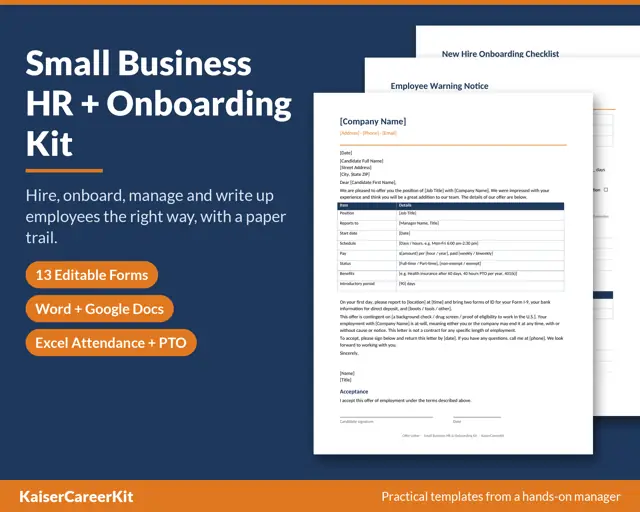
Employee Onboarding Checklist + Small Business HR Forms Kit
Hiring your first employees, or tired of making HR forms from scratch every time?
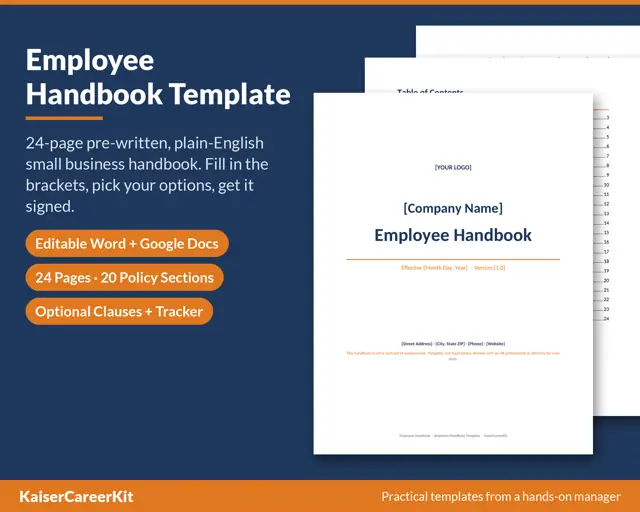
Employee Handbook Template
I've hired, trained and coached crews in a manufacturing shop, a hotel and a paint department.
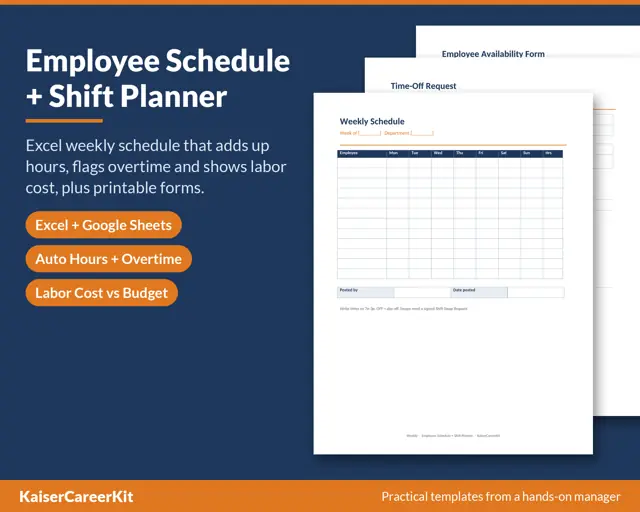
Weekly Shift Planner Excel
I've written schedules for a manufacturing shop, a hotel front desk and housekeeping team, and a paint department.
Optional
Related books

The New Supervisor on the Shop Floor
A Practical Guide for First-Time Managers in Manufacturing, the Trades and Operations
More like this
Work and Hiring
How to Write an ATS-Friendly Resume
Write a resume that a person and an applicant-tracking system can both read: a simple layout, clear headings, and language taken from the job posting.
Work and Hiring
A First-Hire Checklist for a Small Business
A practical checklist for hiring your first employee: EIN and payroll setup, employee versus contractor, W-4 and I-9, and a simple first-week plan.
Free printable
Get the free Christmas word search
Print a sample of our holiday word search puzzles for family game night, the classroom, or a quiet evening with coffee. Big, easy-to-read puzzles.
Free download, no purchase needed. The checkout page may ask for an email address to deliver the file.